
Many buildings get blamed for poor cooling when the equipment is not the real problem. The thermostat gets adjusted, service calls increase, and energy bills climb, yet comfort still drifts from room to room.
That pattern often points to duct leakage. For property managers, facility managers, and building owners, leakage is one of the most expensive hidden performance problems because the system may still run and produce cold air. In contrast, conditioned air escapes before it reaches occupied spaces. Air conditioning contractors evaluate duct leakage by integrating comfort complaints, airflow behavior, and field testing to arrive at a clear diagnosis. The goal is not just to find leaks, but to understand how leakage is affecting delivery, efficiency, and overall building performance.
Hidden Duct Leaks Distort Cooling Performance
- Duct Leakage Rarely Looks Obvious
Duct leakage is often underestimated because the signs are indirect. Occupants report hot and cold spots; conference rooms stay warm in the afternoon, and certain zones never seem to match thermostat settings. Maintenance teams may see no obvious damage at the air handler and assume the issue is equipment capacity, but leakage in concealed duct runs can quietly reduce system performance for months or years.
Contractors begin by treating these comfort patterns as diagnostic clues rather than isolated complaints. They know a system can appear mechanically sound while still failing to deliver conditioned air effectively. Leakage on the supply side can waste cooling before it reaches rooms, while return-side leakage can pull in hot, dusty, or humid air from unconditioned spaces, forcing the system to work harder than expected.
- Complaint Patterns Reveal Leakage Clues
Before testing begins, contractors usually ask how the building behaves over time. They want to know whether discomfort is tied to occupancy hours, weather conditions, certain floors, or specific zones. That pattern matters because leakage often shows up as repeatable inconsistency rather than a total cooling failure.
In a busy Oceanside Office, for example, a facility team may notice that perimeter rooms struggle during peak sun hours while interior areas feel overcooled. That does not automatically prove duct leakage, but it often prompts a closer evaluation of duct routing, insulation, and air loss in the sections serving those spaces. Complaint timing helps contractors narrow where to inspect first and where testing will produce the most useful answers.
- Visual Inspection Sets The Direction
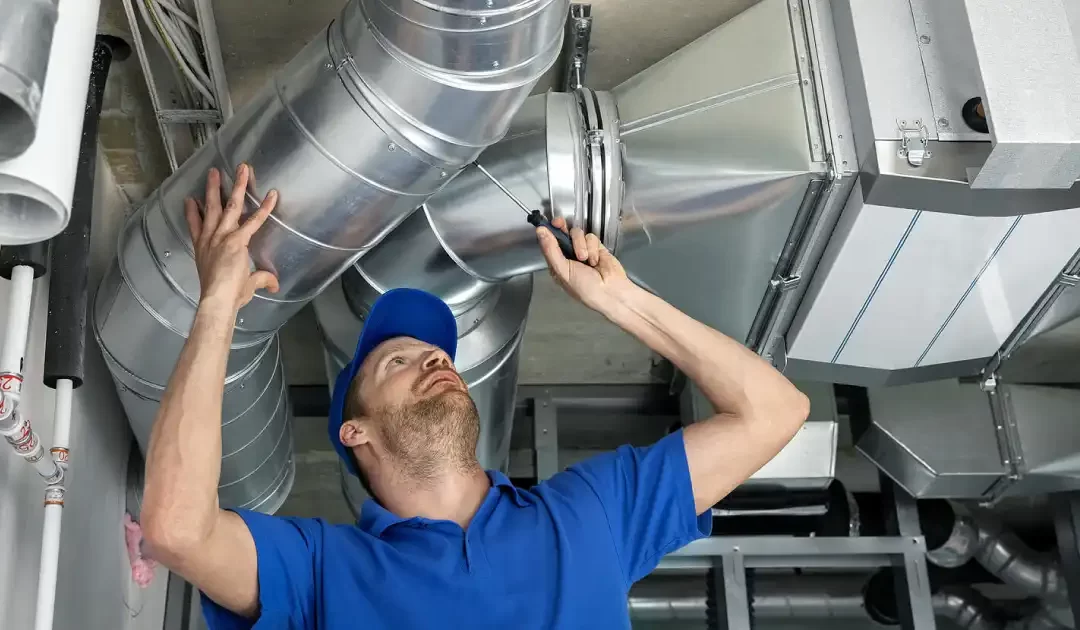
A strong duct leakage evaluation usually starts with a visual inspection of accessible components. Contractors inspect plenums, trunk lines, branch connections, flexible duct runs, boots, collars, seams, and transition points for loose joints, disconnected sections, aging tape, damaged insulation jackets, and gaps around penetrations. They also look for signs of past patchwork that may have addressed symptoms without correcting the root issue.
This stage is more important than many building teams realize. Visual findings help contractors determine whether leakage is likely localized or widespread and whether the problem is poor installation, age-related deterioration, vibration, service access damage, or a combination of factors. It also helps them decide which diagnostic tests make the most sense and where to concentrate those tests to avoid wasted time.
- Airflow Behavior Exposes Distribution Problems
Duct leakage affects airflow delivery, so contractors pay close attention to how air is moving through the system. They compare airflow at supply registers, evaluate return performance, and look for signs that some branches are starved while others receive too much air. Uneven airflow does not, by itself, prove leakage, but it often confirms that conditioned air is not being distributed as intended.
This is where practical field judgment matters. A room that feels warm may not be short on cooling capacity at the equipment level; it may simply be receiving less air due to upstream leakage. Contractors evaluate airflow patterns alongside equipment operation to avoid misdiagnosing the issue as a thermostat problem, a refrigerant issue, or an undersized unit when the real loss is occurring inside the duct system.
- Static Pressure Readings Add Useful Context
Contractors also use static pressure readings to understand system resistance and airflow conditions. While static pressure does not directly measure leakage in every case, it helps identify whether the system is operating under stress and whether airflow delivery problems are likely tied to restrictions, leakage, or both. A system with poor comfort performance and abnormal pressure readings often requires a closer inspection of the ducts.
For property managers, this matters because duct leakage and airflow restriction often overlap. A system may have leaks in some sections and crushed or undersized runs in others. If only one condition is addressed, comfort complaints can continue. Contractors use pressure readings as part of a broader evaluation to distinguish between air loss, airflow blockage, and distribution imbalance, rather than recommending a one-dimensional fix.
- Return Side Leaks Create Hidden Load
Supply leaks waste cooled air, but return leaks can be just as damaging in the opposite direction. When return ducts pull air from attics, crawl spaces, ceiling voids, or mechanical rooms, the system may bring in hot air, humidity, dust, and contaminants, increasing the cooling load and reducing indoor comfort. Occupants may describe uneven temperatures, stale air, or humidity problems even when the system appears to run continuously.
Contractors evaluate return-side leakage because it can change how the entire system behaves. The unit may run longer, coils may accumulate dirt faster, and indoor conditions may feel unstable during high-load periods. In commercial buildings, return leakage can also complicate zone balance and create pressure differences that affect doors, corridors, and adjacent spaces—identifying that the hidden load is a major part of accurate diagnosis.
Better Delivery Starts With Better Evaluation
Air conditioning contractors evaluate duct leakage issues by combining complaint history, visual inspection, airflow behavior, pressure readings, and targeted testing into one practical diagnostic process. That process matters because duct leakage is rarely visible at the thermostat and is often mistaken for equipment failure.
For property managers and building owners, the key advantage of a thorough evaluation is better decision-making. It reveals whether the building is losing conditioned air, pulling in unwanted heat and humidity, or simply distributing air poorly across occupied spaces. When contractors clearly identify those losses, repairs become more effective, comfort becomes more consistent, and energy use is much more likely to move in the right direction.
