
The academic landscape in 2026 is vastly different from what it was even five years ago. For undergraduate students, the challenge isn’t just about memorizing debits and credits anymore; it’s about navigating a world where digital transformation, real-time data, and global standards collide. Accounting is often called the “language of business,” but for many, it feels like a dialect that is increasingly hard to fluently speak without the right roadmap.
The transition from high school mathematics to university-level financial reporting can be jarring. You are no longer just solving for $x$; you are interpreting the lifeblood of an organization. In this environment, students frequently find that traditional study methods fall short. Whether you are studying in London, New York, or Sydney, the pressure to maintain a high GPA while grasping intricate concepts like forensic auditing or consolidated financial statements is immense. Many students have realized that localized support, such as seeking out my assignment help australia services, provides the necessary bridge to translate complex global theories into practical, high-scoring submissions.
1. Reconstruct Your Relationship with the Accounting Equation
Everything in accounting flows from one central truth:
$$Assets = Liabilities + Equity$$
In 2026, students often make the mistake of viewing this as a simple formula to be balanced. Instead, treat it as a story. Every transaction tells a tale of where value came from and where it went.
To master this, stop looking at spreadsheets and start looking at real-world scenarios. If a company buys a delivery van with cash, the story is a “transformation of assets.” If they buy it on credit, it’s an “increase in resources fueled by future obligations.” When you visualize the “why” behind the entry, the “how” becomes second nature.
2. Leverage the Power of Visual Data Mapping
Textbooks are often dense, but the human brain is wired for imagery. Modern accounting involves massive datasets that can be overwhelming. One of the most effective ways to simplify this is through the use of flowcharts and decision matrices.
| Concept | Visual Tool | Purpose |
| Cash Flow | Waterfall Chart | To see exactly where liquidity is leaking or growing. |
| Inventory (LIFO/FIFO) | Layered Pyramid | To understand how cost flows through different periods. |
| Consolidation | Parent-Subsidiary Map | To visualize how different entities merge into one report. |
By creating these diagrams yourself, you move from passive reading to active learning. This is particularly helpful when dealing with “Internal Controls”—a topic that is purely logical but often taught in a dry, abstract manner.
3. Master the “Threshold Concepts” Early
In education theory, a “threshold concept” is a core idea that, once understood, changes your entire perception of the subject. In accounting, these are usually Accruals and Matching Principles.
If you don’t grasp why we record expenses when they are incurred rather than when the cash leaves the bank, the rest of the curriculum will feel like a house of cards. Spend double the time on these foundational pillars. Once the logic of accrual accounting clicks, more advanced topics like deferred tax assets or pension accounting suddenly lose their intimidation factor.
4. Utilize Specialized Technical Support
As you move into the middle of your degree, the complexity of your coursework will inevitably spike. General study groups are great, but they often lack the technical depth required for advanced modules. This is where many high-achieving students pivot toward targeted expertise.
For instance, when faced with grueling ledger reconciliations or complex tax law assignments, using a dedicated accounting assignment help resource from Myassignmenthelp Services can provide the clarity that a standard lecture might miss. This isn’t just about getting an answer; it’s about seeing the step-by-step logic of a professional practitioner. Seeing how an expert structures a Cash Flow Statement or a Balance Sheet according to IFRS standards serves as a practical template for your own future work.
5. Bridge the Gap Between Theory and ESG Reporting
In 2026, “Accounting” no longer means just “Financial Accounting.” The rise of ESG (Environmental, Social, and Governance) reporting means that modern students must understand how to account for carbon footprints and social impact.
Don’t just study the numbers; study the integrated reports of global companies like Microsoft or Unilever. See how they balance profit with purpose. Understanding these non-financial metrics now will make you significantly more employable. It turns you from a “bookkeeper” into a “strategic consultant” who understands the broader implications of corporate transparency.
6. Embrace the “Double-Entry” Mental Model in Daily Life
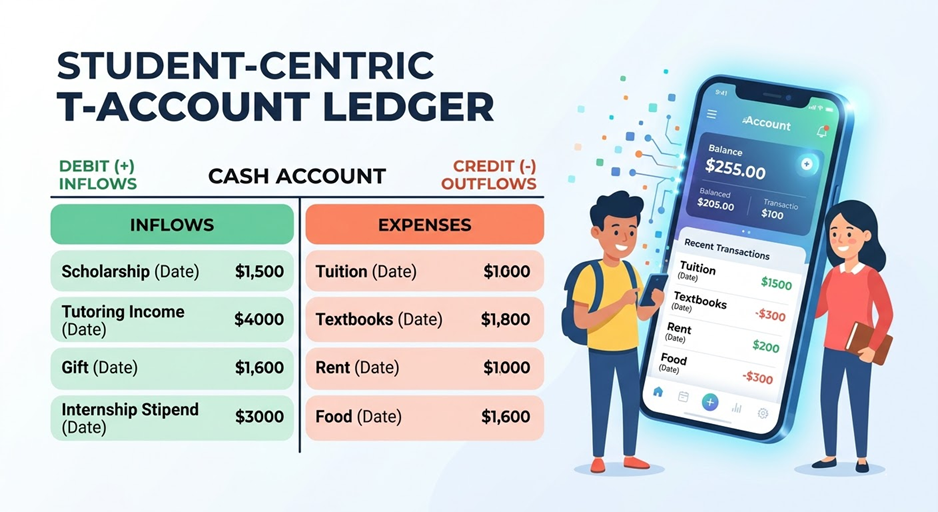
The best way to learn a language is immersion. Apply the double-entry system to your personal life or a small side project. If you spend $50 on a textbook, don’t just see it as “money gone.” See it as a “Credit to Cash” and a “Debit to Education Asset.”
By mentally processing your own transactions through a ledger, you train your brain to think in terms of dual effects. This habit eliminates the common “one-sided entry” errors that plague undergraduate exams. It makes the logic of the T-account feel like a natural extension of your thought process rather than a chore.
7. Simulate Real-World Audits
Instead of just doing the practice problems at the end of the chapter, try “Reverse Accounting.” Find a finished financial statement and try to work backward to the original transactions. This “investigative” approach is exactly what auditors do. It forces you to think about how errors occur and where fraud might be hidden. This level of critical thinking is what separates a student who passes from a student who excels.
FAQ: Navigating Undergraduate Accounting
Q: Why is accounting harder than other business subjects?
A: Accounting is cumulative. In subjects like Marketing, you can often master Chapter 5 without fully knowing Chapter 2. In Accounting, every chapter builds directly on the previous one. If your foundation is shaky, the whole structure will eventually lean.
Q: How do I stay updated with changing tax laws in 2026?
A: Follow official bodies like the IASB or FASB on professional networks. They often release “Student Summaries” of new standards that are much easier to digest than the full legislative text.
Q: Can I still get a job in accounting with AI taking over data entry?
A: Absolutely. AI handles the “entry,” but humans handle the “interpretation” and “ethics.” The role of the 2026 accountant is to be a data storyteller and a moral compass for the company.
Q: Is it okay to use external help for my assignments?
A: Using resources as a learning supplement is a smart strategy. The goal is to use these tools to understand the methodology so that you can apply those same skills independently during your mid-terms and finals.
About The Author: Min Seow
As a digital strategist and academic consultant at Myassignmenthelp Services, I specialize in helping university students navigate the intersection of complex coursework and modern technology. With a background in search engine optimization and educational content strategy, my goal is to bridge the gap between abstract academic theories and practical, real-world application.
